

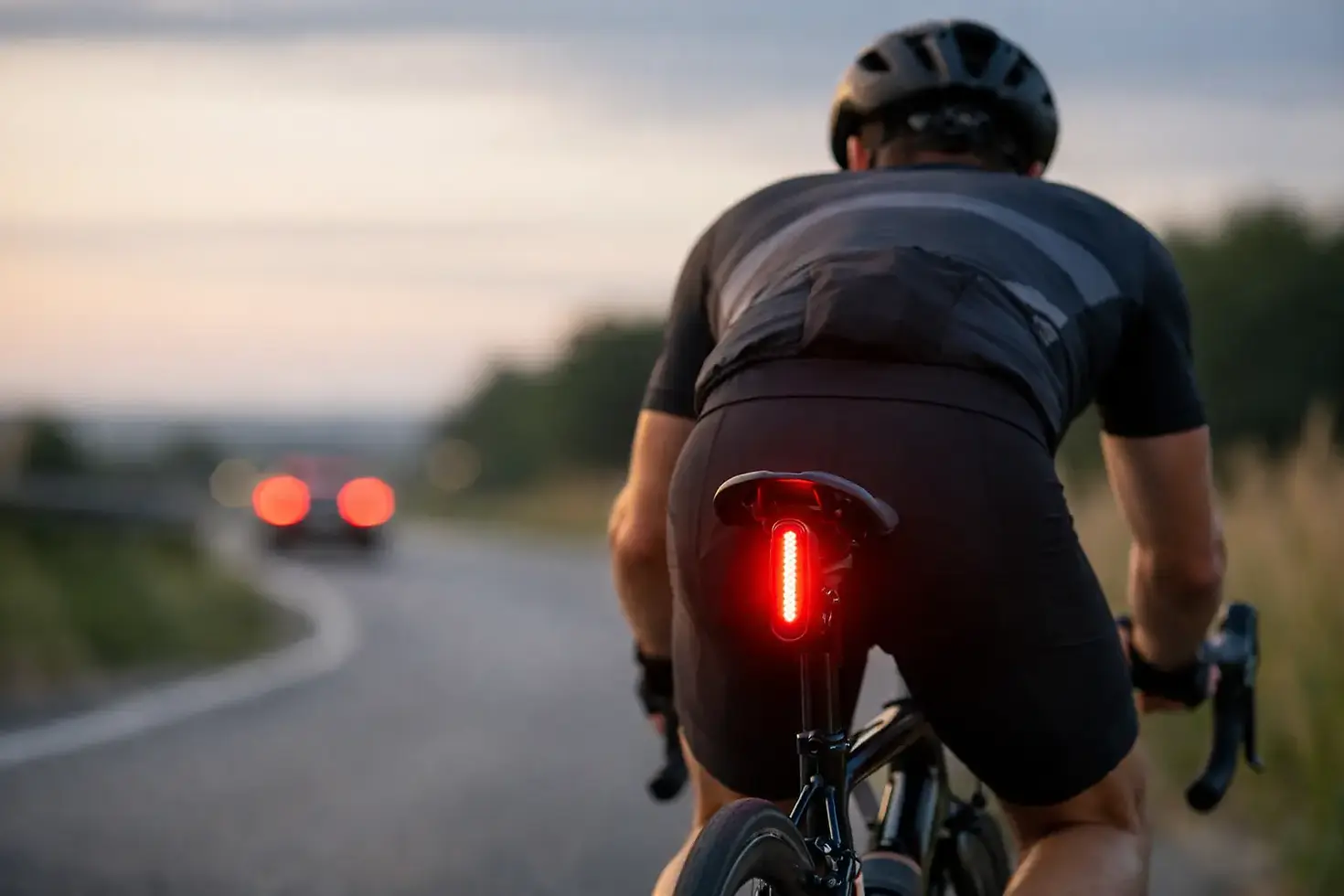
Rear Light for Road Cycling That Really Works
- Xavier

- Jun 6
- 6 min read
You can do everything right on the bike - hold your line, wear bright kit, pick the safer route - and still be missed by a driver turning across you at dawn. That is exactly why a rear light for road cycling needs to do more than blink at the car behind you. On real roads, in patchy light, roundabouts, intersections and shoulder checks, visibility is not just about what is directly behind. It is about being seen early, clearly and from more angles.
What a rear light for road cycling should actually do
A lot of riders still buy rear lights the same way they buy bidons or tyre levers - small, cheap, and easy to tick off the list. That works until you look at how many close calls happen from the side, not just from a vehicle following directly behind. A standard tail-light often throws a narrow beam backwards. Fine in a straight line. Less convincing when a driver is approaching from an angle, pulling out from a side street or sweeping through a roundabout.
That is the real job of a rear light. It should create presence, not just a pinpoint. Bigger illuminated surface area helps. Side visibility helps. Consistent brightness helps. If the light disappears every time your body shifts, your saddle bag blocks it, or the road pitches up, it is not doing enough.
For road cycling in Australia, that matters even more. Plenty of rides start before sunrise to beat traffic or heat. Plenty finish in fading light. Urban commuters deal with buses, parked cars and drivers glancing at mobiles. Recreational riders hit regional roads where speeds are higher and reaction time is shorter. In all those settings, the best rear light is the one that gets noticed before you need it to.
Brightness matters, but shape matters too
Cyclists often get drawn to lumen numbers because they are easy to compare. More sounds better. But lumen claims alone do not tell you how visible a light feels in traffic. A tiny, intensely bright point can still be easy to miss at an angle, especially against busy backgrounds full of brake lights, signs and street lighting.
This is where design makes a genuine difference. A light with a larger illuminated area tends to register faster in a driver's peripheral vision. It looks more like an object in the road environment and less like a distant speck. That matters when drivers are scanning quickly rather than staring directly at you.
The same goes for 360-degree or wraparound visibility. A rear light designed to be seen from the side closes one of the biggest safety gaps in road riding. It gives you a better chance of being noticed by traffic crossing your path, not only by the vehicle sitting neatly in your lane behind you.
If that sounds like a small detail, think about where riders are most exposed. Intersections. Driveways. Slip lanes. Roundabouts. Those are side-angle situations. A light built only for rear-facing visibility leaves too much to chance.
Flash mode or steady mode?
It depends on where and when you ride.
Flash mode is excellent for attracting attention in low light and cluttered traffic. It creates contrast and helps separate you from the background. For commuting through suburban streets or filtering through morning traffic, a well-judged flash pattern can make you much more obvious.
Steady mode has its place too. On bunch rides, in dim conditions, or on quieter roads, a steady beam can be easier for others to track without being harsh. Some riders also prefer a pulsing mode, which sits between the two - more eye-catching than steady, less aggressive than a hard flash.
The catch is that not all flash patterns are equal. Some are so erratic they become annoying without improving recognition. Others are too weak in daylight to matter. A good rear light gives you useful modes, not just more modes. The goal is simple: be seen when you need it most, without adding distraction or fuss.
Mounting position can make or break visibility
Even a strong light underperforms if it is mounted badly. This gets overlooked all the time.
Seatpost mounting is common for a reason. It is central, neat and usually unobstructed. But not every road bike has loads of usable seatpost exposed, and some aero posts limit compatibility. Saddle bags can block part of the beam. Jackets can drape over the light. Deep riding positions can change how visible it is from behind.
That is why flexibility matters. A rear light that can mount to the bike, the bag or even clothing gives you more options to keep it visible. For commuters and endurance riders especially, that versatility is not a bonus feature. It is practical safety. The best light is the one you can place where it will actually be seen on your setup.
This is one area where innovative designs stand apart from basic clip-on tail-lights. A more adaptable format lets riders solve real-world problems instead of forcing every bike into the same mounting pattern.
What road riders in Australia should prioritise
Local riding conditions change the brief. Heat, surprise showers, road spray, long daylight transitions and rougher surfaces all test gear differently than a quick city spin in perfect weather.
First, weather resistance is non-negotiable. If you ride year-round, your rear light must handle drizzle, road grime and the occasional soaking without becoming unreliable. Second, USB rechargeability is a big advantage. Disposable batteries are a nuisance, and they have an annoying habit of dying when you are already late.
Run time matters too, but only in context. A commuting rider doing short weekday trips needs something different from a roadie doing four-hour dawn rides on weekends. If you regularly forget to charge gear, pick a light with realistic endurance and simple charging habits. Clever tech is no help if it is flat in your drawer.
Then there is durability. A rear light for road cycling gets vibration, sweat, dust and constant handling. If it feels flimsy, it probably is. A premium light should feel like safety equipment, not a toy.
Why standard tail-lights often fall short
The traditional bike tail-light was built around one simple idea: point a red light backwards. That is better than nothing, but better than nothing is not a serious safety standard.
The limitation is directional visibility. When a light is tiny and rear-facing only, it relies on the perfect alignment of rider and driver. Roads are rarely that tidy. Drivers drift within lanes. Riders move around parked cars. Vehicles approach from side streets. The environment is dynamic, not straight and predictable.
That is why more cyclists are moving toward lights with larger illuminated profiles and side visibility. They do not just tick the compliance box. They make the rider easier to notice as a physical presence on the road.
Fibre Flare built its reputation on exactly this gap. Instead of behaving like a basic pinpoint tail-light, a fibre-optic LED hybrid creates broad, wraparound illumination that can be seen from multiple angles at over 400 metres. For riders who want more than a token rear blinker, that is the difference between being lit up and being genuinely visible.
How to choose the right rear light without overthinking it
Start with your riding pattern. If you ride mostly in dense traffic, prioritise side visibility and a larger illuminated area over flashy specs on the box. If you ride long stretches on open roads, look for strong brightness, stable mounting and dependable run time.
Next, look at where you will mount it. Your bike fit, saddle bag, clothing and frame shape all matter. A light that works brilliantly on one setup can be half-hidden on another. If you use more than one bike, or switch between commuting and weekend riding, flexibility is worth paying for.
Then be honest about convenience. Rechargeable is easier for most riders. Simple controls are better than fiddly ones. A light that clips on quickly and survives daily use is far more likely to be used every single ride.
And finally, think beyond the direct rear view. The smartest question is not, "How bright is it from behind?" It is, "How visible am I when traffic sees me from the side, from an angle, or in poor light?" That is where many near misses happen. That is also where better design earns its keep.
A rear light should not be an afterthought on a road bike. It is one of the few bits of gear whose entire purpose is to protect you from not being seen. Choose one that treats that job seriously. When the light is right, you are not just riding with a red dot on the back of the bike. You are making a clear statement to every driver around you: I am here, I am moving, and you can see me properly.


Comments