

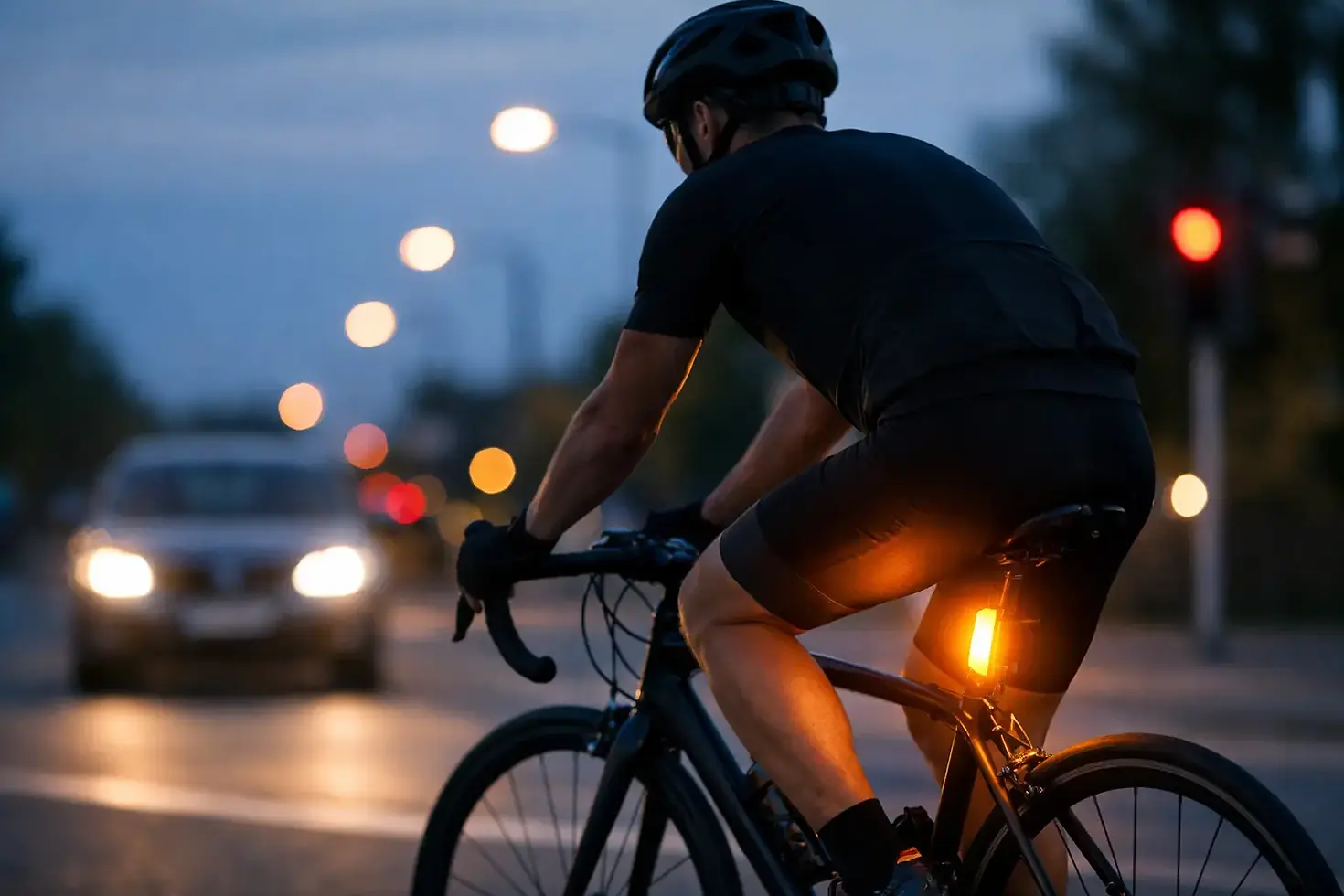
Why Cyclists Need Side Visibility

A driver waiting to turn across your lane usually is not staring straight at your rear light. They are scanning for movement, judging gaps, and making a fast decision from an angle. That is exactly why cyclists need side visibility. If your light only throws a narrow beam behind you, there is a dangerous window where you can be on the road but not truly seen.
Too many riders assume a bright rear light is enough. It is not. Rear visibility helps the cars directly behind you. Side visibility helps everyone else - drivers at intersections, vehicles pulling out of side streets, cars changing lanes, and anyone approaching from an angle in low light, rain or cluttered urban traffic. If you ride at dawn, dusk, after dark, or through mixed traffic at any hour, side visibility is not a nice extra. It is part of basic road presence.
Why cyclists need side visibility in real traffic
Most close calls do not happen in a perfect straight line. They happen when traffic crosses your path. A motorist turns left across a bike lane. A car noses out from a side street. A ute drifts wide through a roundabout. A driver glances quickly, sees no obvious threat, and moves.
That is where narrow, rear-facing lights fall short. They can be very bright from directly behind, yet almost disappear when viewed from the side. On paper, a standard tail-light can sound impressive. On the road, angles matter more than marketing claims.
Side visibility gives you earlier detection. It lets other road users identify you before you enter the conflict point, not after. That extra moment can mean the difference between a driver waiting and a driver rolling through your line.
For Australian riders, this matters even more because our roads often combine fast-moving traffic, parked cars, inconsistent bike infrastructure and busy intersections. A commuter heading home in fading light through Sydney, Melbourne or Brisbane faces a different visibility challenge from someone riding a quiet shared path. In traffic, being visible from one direction is not enough.
The problem with standard rear lights
A conventional tail-light is built around a simple idea - point a beam backwards and make it flash. That works up to a point. But the problem is the shape of the light output and the size of the illuminated area.
A small directional light can be powerful yet still easy to miss from the side. If the lens is tiny, the visible surface is tiny. If the beam is tightly focused, the effective viewing angle can be limited. Drivers do not always get a clean, centred view from directly behind your saddle. Often they catch only a partial glimpse from the side as they approach, turn or overtake.
This is where many riders get a false sense of security. They think, my light is bright, so I am covered. Brightness matters, but so does where the light can actually be seen from. A light that disappears at an angle is solving only half the problem.
Why side visibility matters most at intersections
Intersections are decision zones. Everyone is reading speed, distance and right of way at once. Cyclists are especially vulnerable because they occupy less visual space than a car and can blend into the background, particularly at dusk.
When a driver is turning, they are often scanning across your path rather than directly behind you. A side-visible light creates a broader visual signature. Instead of showing a tiny point only when perfectly lined up, it announces your position across a wider range of angles.
That wider signature does two things. First, it helps drivers register that you exist. Second, it helps them judge where you are moving. Both matter. Being noticed late is better than not being noticed at all, but being noticed early is what gives everyone time to react properly.
Roundabouts are another weak point. Cars enter and exit at different angles, and riders can pass through a driver’s peripheral view for only a second or two. If your visibility depends on a narrow rear beam, you are relying on ideal alignment in a situation that is rarely ideal.
Why cyclists need side visibility beyond night riding
This is not only a night riding issue. Low sun, overcast mornings, winter afternoons, tree-lined roads, spray, shadows and glare all reduce contrast. In those conditions, cyclists can be harder to pick out even when it is technically daytime.
That is why smart riders use lights well before full darkness. Side visibility strengthens your presence when the road environment is visually messy. Think of busy arterial roads, reflective shopfronts, headlights, brake lights and wet bitumen. In that visual noise, a small rear-only light can get lost.
A larger illuminated shape visible from multiple directions cuts through better. It gives your bike and body a clearer outline. It says rider here, right now, from more than one angle.
Bigger illuminated area changes the game
One of the most overlooked parts of visibility is surface area. A larger illuminated section is easier for the human eye to catch than a tiny flashing dot. That does not just make a light look better. It makes it work harder in real conditions.
A broad light source is more noticeable in peripheral vision, which is critical because drivers are not always looking straight at you. They are checking mirrors, scanning lanes and watching other vehicles. If your lighting only rewards direct attention, it is asking too much from distracted traffic.
This is why flexible fibre-optic style lighting stands apart from standard tail-lights. It can create a longer, more obvious illuminated profile that stays visible from the rear and side. Instead of one concentrated point, you get a stronger visual footprint around the bike, bag or rider.
That difference is not cosmetic. It is functional safety.
Placement matters as much as the light itself
Even the best light can underperform if it is tucked under a saddlebag, blocked by a jacket, or mounted too low behind a mudguard. Side visibility improves when the light is positioned where it can be seen cleanly from multiple approaches.
That may mean mounting on the seatpost, seatstay, rack, backpack or clothing, depending on the bike and your setup. Commuters often carry gear that blocks traditional rear lights. Road riders may prefer a cleaner bike profile. Gravel riders deal with dust, vibration and odd luggage arrangements. There is no single perfect mount for every rider.
What matters is this: your light should remain obvious from behind and from the side, even when you are pedalling, carrying gear, or shifting position on the bike. If your current setup vanishes when viewed from an angle, it needs work.
Not all visibility claims are equal
Some lights boast huge lumen numbers but still offer poor real-world coverage. Others are fine for occasional use on quiet roads but fall short in heavy traffic. The right question is not simply how bright is it. The better question is how visible am I from the angles that matter most.
Look at beam spread, illuminated area, mounting flexibility, weather resistance and rechargeability. A light you forget to charge or cannot mount properly is not helping you much. Practical safety gear should fit normal riding habits, not create more hassle.
This is where a purpose-built visibility system earns its keep. Fibre Flare was designed to close the side visibility gap that standard bike lights leave open, with 360-degree illumination, a large illuminated surface and flexible mounting across bikes, bags and clothing. That makes sense for riders who want stronger visibility without overcomplicating their setup.
Side visibility is about confidence, not paranoia
There is a difference between fear-based riding and smart preparation. Good visibility does not make you invincible, and it does not replace road awareness. You still need lane judgement, predictable positioning and attention at every intersection.
But better side visibility changes the odds in your favour. It gives drivers more chances to see you sooner. It reduces the risk that you disappear at exactly the wrong angle. And it makes your presence clearer in the messy, imperfect conditions where many bike crashes begin.
If you are investing in safety, do not stop at being visible from behind. Be seen across the road, across the intersection and across the split second when a driver decides whether to move. That is where side visibility proves its value - and why the smartest riders treat it as essential, not optional.


Comments